Mira Analytics
Background

MIRA ANALYTICS

AI-driven, real-time, explainable oversight of endpoints, raters, and sites — on your blinded trial data.

Platform

All trial analytics in one secure platform

A single real-time analytics platform for the whole team — built on deep insight, clinical-grade security, and compliance from day one.

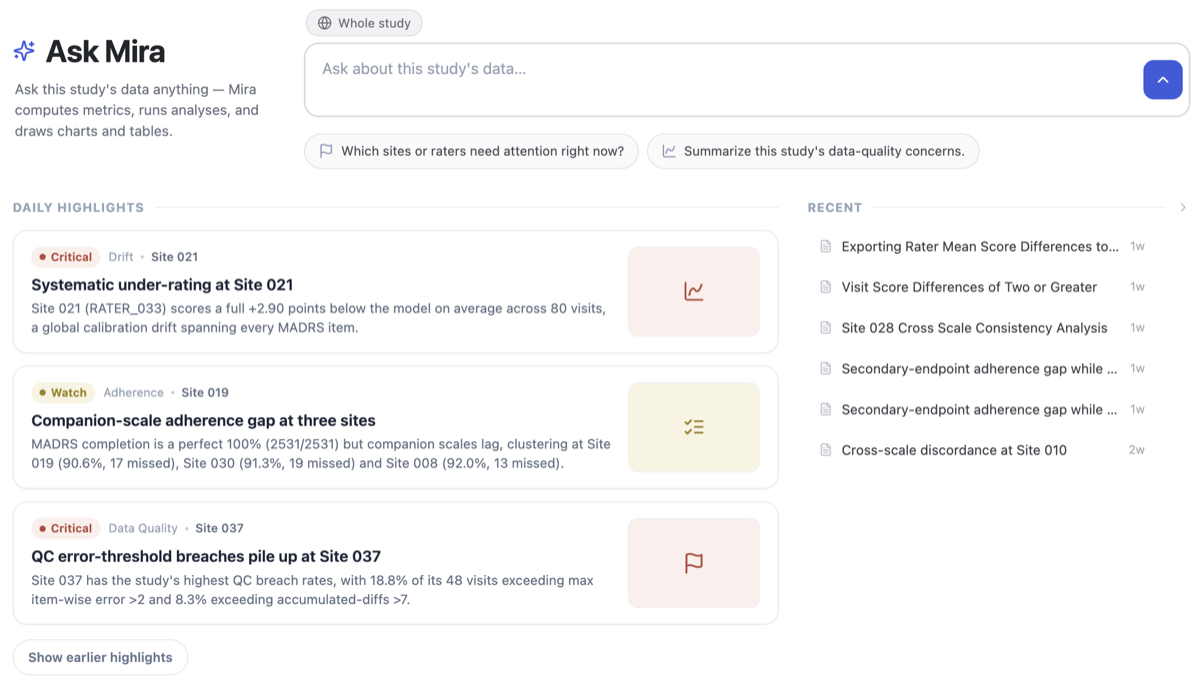
Insights: See the big picture across sites and raters, then drill from broad trends down to important details. Mira weighs each site against the others and the study as a whole, surfacing endpoint reliability, scoring drift, and rater consistency — early enough to intervene with timely, actionable feedback, well before database lock.

Security: Flexible deployment in your own cloud or our dedicated Virtual Private Cloud. Study data stay within secure, compliant environments tailored to your needs.

Connectivity: Mira sits as the analytics layer on top of the data you already collect. It runs in real time, connects to any data lake or warehouse, and works with your EDC, CTMS, or review tools — pulling in the data that matters, wherever it lives.

Dashboard overview

Endpoint scoring

Automated scale ratings

From endpoint capture to AI-driven scoring.

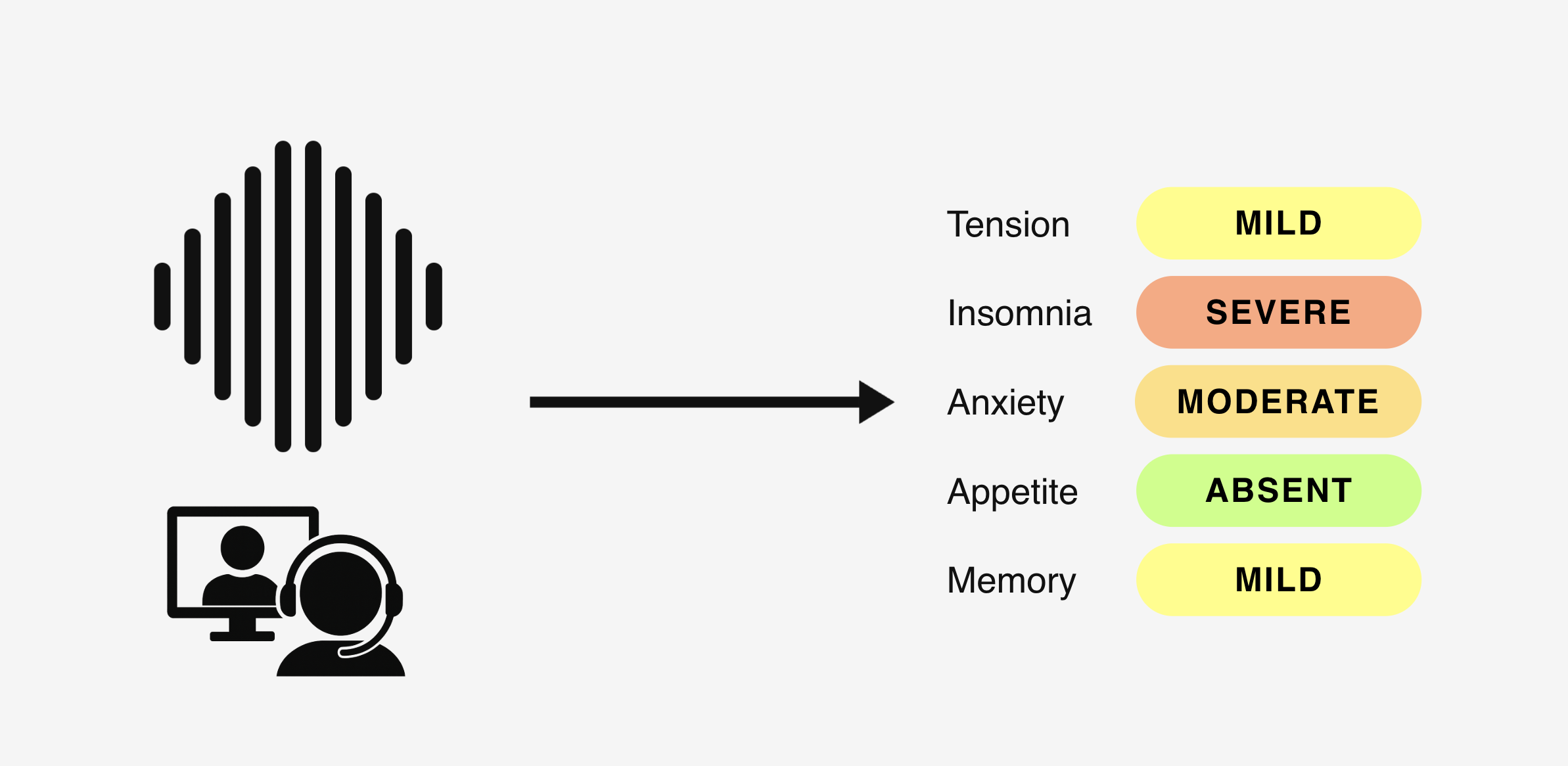
Raters administer assessments and Mira ingests questionnaire audio locally, producing item-level and total scale scores for continuous oversight of rater performance. One engine works with any interviewer-rated scale or questionnaire, and travels across languages, sites, and accents.

Interview waveform flowing into a Mira engine and bar chart of scale ratings.

Interview waveform flowing into a Mira engine and bar chart of scale ratings.

Explainability

Scores that point back to the interview.

Mira's scoring can be traced back to specific parts of the scale interview. Explainability helps clinical teams understand which parts of the dialogue drove the model's judgement — making reviews faster, more consistent, and easier to trust.

Insomnia Severe
How have you been sleeping lately? 09:14
Not terrible, but not great either. 09:15
How long does it usually take you to fall asleep? 09:19
On good nights maybe half an hour. Sometimes longer, but nothing extreme. 09:21
And on the bad nights? 09:25
I’m awake until three or four almost every night, and when I do sleep I’m up again after an hour. 09:27
Mira Model output Short, fragmented sleep The participant reports frequent nights with delayed sleep onset and repeated awakenings — a pattern typical for severe insomnia.
How do these nights affect your day? 09:33
I can’t focus in meetings and I’m forgetting simple things. I feel wiped out most days. 09:35
Mira Model output Daytime cognitive impact The participant mentions reduced concentration and mistakes with routine tasks — evidence that their insomnia is functionally impairing.
How’s your mood and appetite otherwise? 09:40
My mood’s okay, and I still go for walks. Just wish I wasn’t so tired. 09:43

Mira highlights parts of the insomnia dialogue that support a severe rating.

Rater analytics

From single predictions to rater performance.

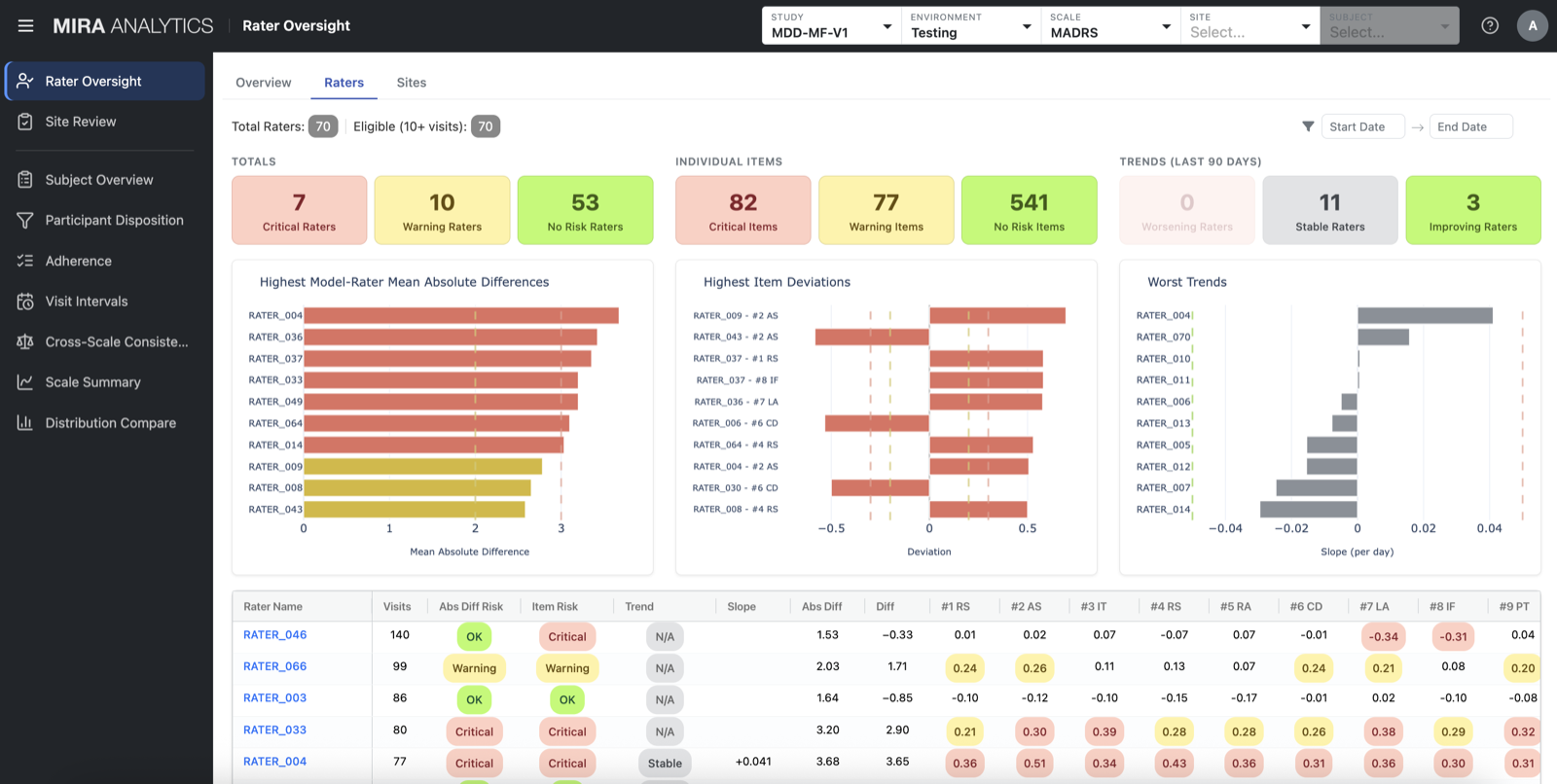
Individual scores aggregate into the intuitive analytics of rater behavior, and can highlight issues such as drift, over- or under-scoring tendencies. These metrics can be viewed on an individual assessment basis or longitudinally as they evolve throughout the study.

Monitor rater scores over time to visualize trends.

Monitor rater scores over time to visualize trends.

Site oversight

Data consistency

Are the data aligned?

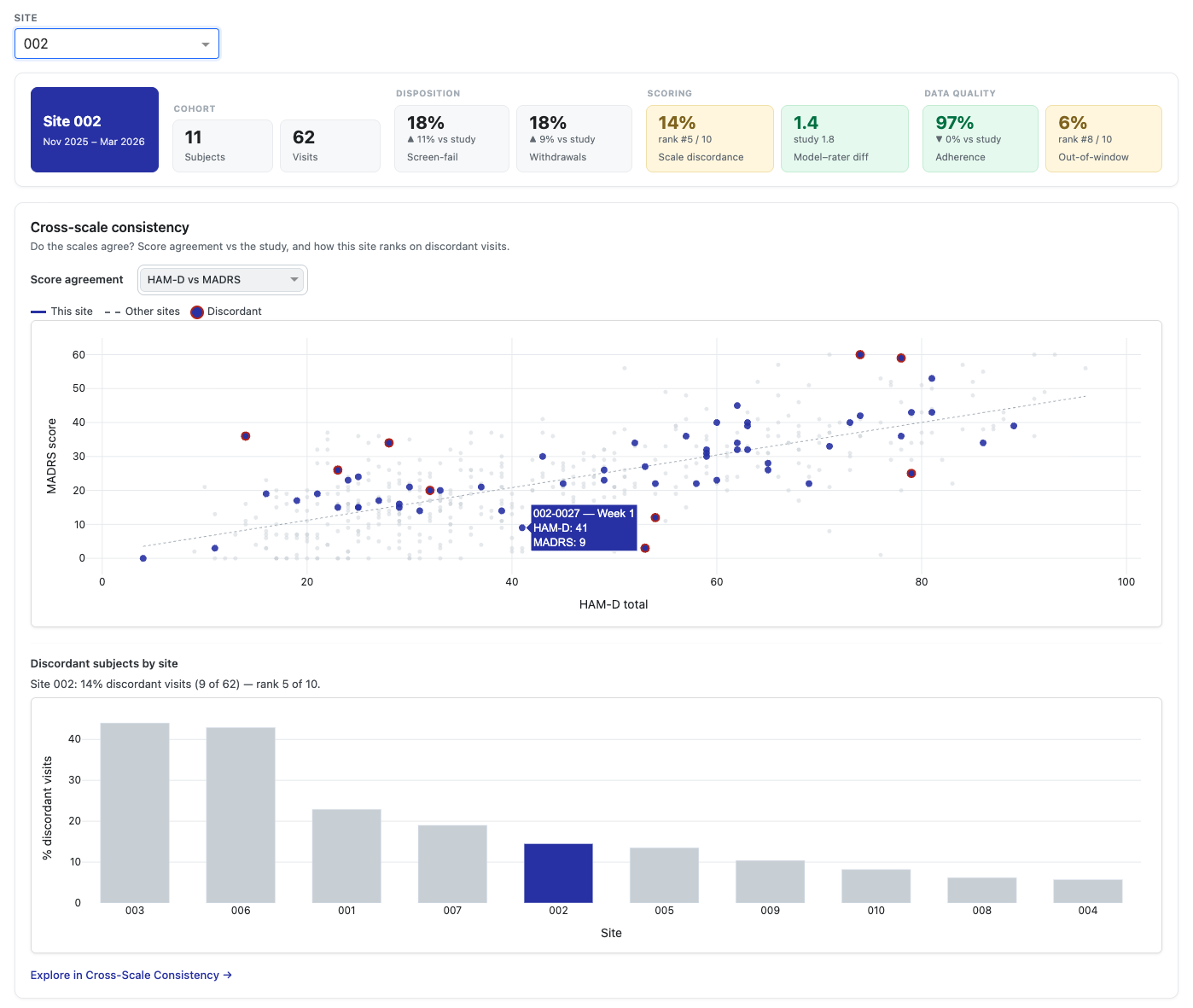
Mira checks that every scale agrees with the others — and, for the primary endpoint, with Mira's own model scores — visit by visit. Each site is benchmarked against all other sites and the study average, then ranked by how often its data disagree — so outliers surface in context, well before database lock.

Scatter of HAM-D vs MADRS with discordant visits highlighted, and a bar chart ranking sites by % discordant visits.
Operations

Is the site on track with enrollment and protocol?

Participant disposition and enrollment over time — so recruitment or retention outliers, withdrawals, and screen failures stand out immediately. Scale adherence and visit-interval deviation surface missed assessments and out-of-window visits, all in one per-site view.

Cumulative enrollment over time and a per-site stacked bar of screen-failed, withdrawn, and completed subjects.

Our results

The founders have a long track record of building internal AI tools for the pharma industry — including the oversight platform used at Definium Therapeutics (formerly MindMed) to help monitor key endpoints (HAM-A and MADRS) in their Phase 3 clinical programs.

The work “Using Large Language Models for Endpoint Oversight” received the Distinguished Poster Award at ISCTM 2025.

  • 95.2% accuracy on central rater training.
  • 1.57 (± 1.39) point average difference vs. central raters in Phase 2b.
  • Deployed in ongoing Phase 3 to monitor HAM-A & MADRS.

“Using Large Language Models for Endpoint Oversight”, ISCTM 2025 — poster · abstract

Scatter plot of Hammy vs central raters.

Founders

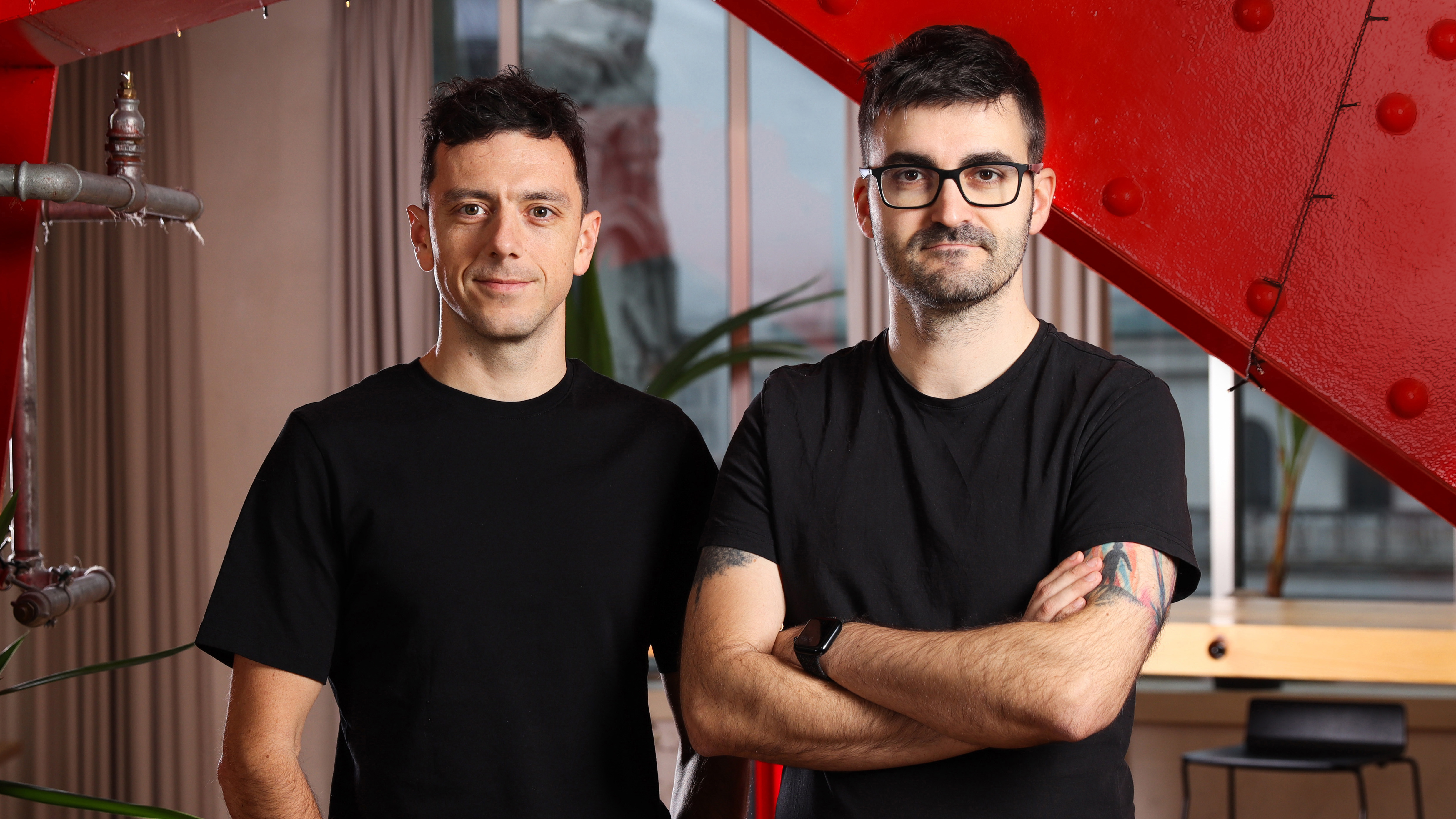
Founders of Mira Analytics: Adam and Miguel.
Adam — Mira Analytics founder

Adam

Co-Founder & Chief Executive Officer

Adam is a seasoned machine-learning specialist with over a decade of experience building ML products in both startup and corporate environments. He has worked in leadership roles, bringing machine-learning solutions, scalable data architectures, and practical AI applications to real-world problems.

in LinkedIn
Miguel — Mira Analytics founder

Miguel

Co-Founder & Chief Technology Officer

Miguel holds a Ph.D. in Artificial Intelligence, having also over a decade of experience working across multiple healthcare startups as a machine learning engineer and technical lead, building AI-driven products and scalable data and analytics systems for clinical and healthcare applications.

in LinkedIn

Reach out

I’m interested in: